


Go to Section
Share on


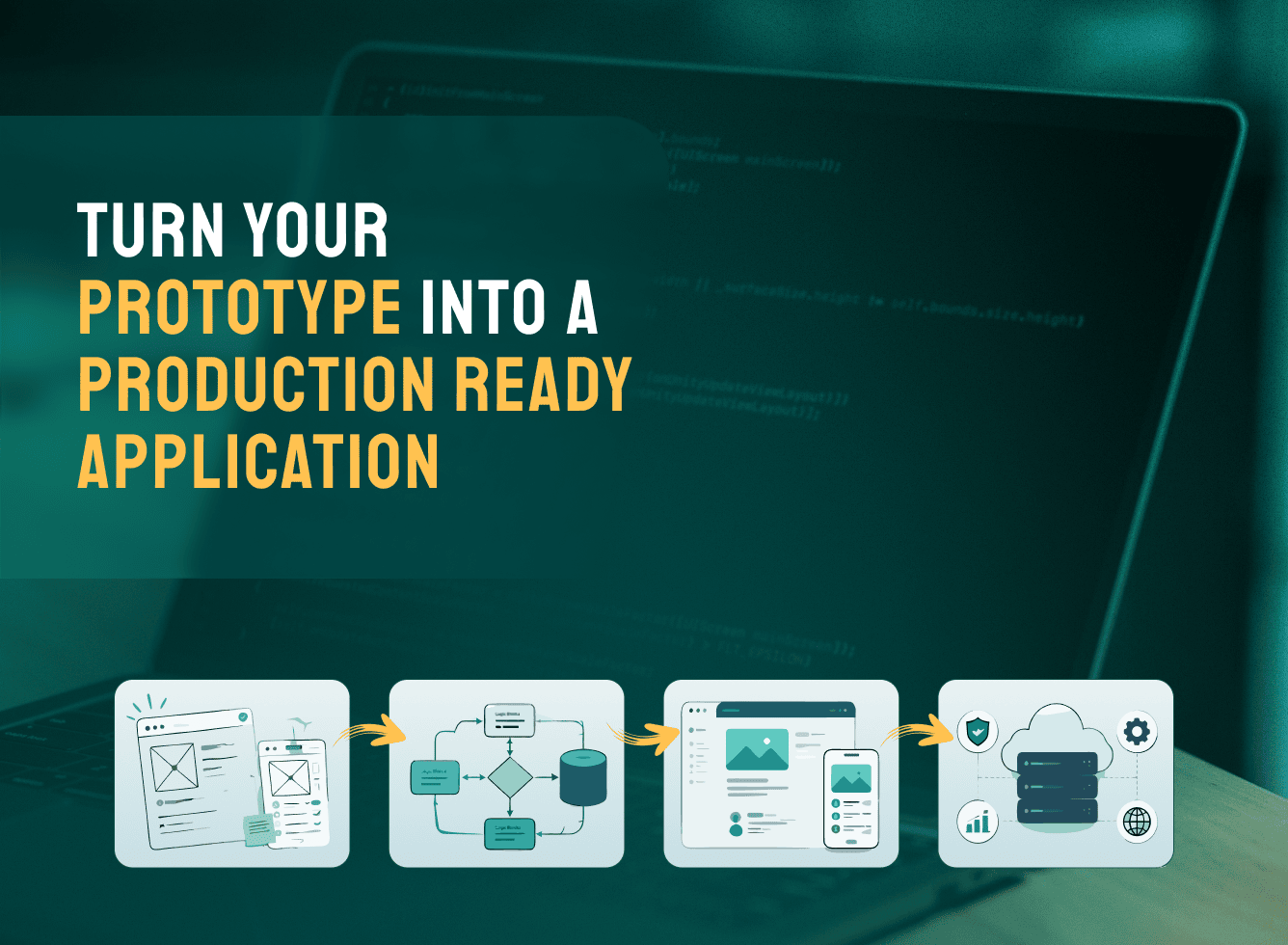
A working prototype creates momentum, but taking it into production requires decisions about architecture, integration, security and ongoing operation. Those decisions determine how much of the initial speed translates into lasting business value.
Moving from vibe coding to production means assessing what can be retained, addressing gaps that affect reliability and bringing in the engineering expertise needed to support real users and future growth.
1. Define the Production Commitment
Production readiness depends on the application’s role in the business. An internal application supporting a small team has different obligations from a customer platform handling transactions across several markets.
Before agreeing a delivery plan, establish who will depend on the application, which activities it will support and what information it will process. The consequences of interruption or incorrect results should guide the requirements.
This also creates a boundary for the initial release. Adding a customer group or connecting another business system can change permissions, introduce data dependencies and increase support requirements.
A clear scope gives the engineering team a basis for proportionate decisions and helps the business distinguish immediate priorities from later investment.
2. Assess What the Existing Application can Support
Visible completeness reveals little about the engineering work remaining. An assessment needs to examine the architecture, business logic, data model, external dependencies and deployment arrangements.
Some components may need focused improvements. Others may require restructuring because their original assumptions no longer fit the intended use.
An application created for one organisation, for example, may require substantial changes before serving multiple customers. Customer separation affects records, permissions, reporting and background processes. Treating it as an adjustment to the sign in experience would underestimate the work.
Solution architects and technical leads establish these dependencies and assess what to retain, refactor or replace. Their recommendations should explain both the delivery implications and the cost of leaving limitations unresolved.
The outcome should be a prioritised plan with explicit uncertainties, providing a credible basis for budgets and launch commitments.
3. Connect the Application to the Business Environment
Prototypes can demonstrate value using sample data and simplified integrations. Production requires the application to function within the organisation’s actual environment.
That means establishing where information originates, which system owns it and how changes move between applications. Transactions, approvals and customer records must remain consistent across those connections.
Full stack AI developers address the interface, backend and integrations. Data engineers establish the structures and pipelines that keep information usable and reliable.
If an external service fails during a transaction, the application must preserve an accurate state. The business needs to know whether the transaction completed, whether another attempt is safe and whether intervention is required.
These decisions protect the application’s operational value. Persistent reconciliation and manual investigation can quickly erode the gains demonstrated by the prototype.
4. Evaluate AI Capabilities Against Business Consequences
Where the application includes generative AI, predictive models or agents, successful execution is only part of readiness. Outputs and actions need evaluation against their intended use.
A knowledge assistant should retrieve information the user is authorised to access. A predictive feature needs assessment against the decisions it informs. An agent that changes records requires defined permissions and clear thresholds for human approval.
AI engineers address model integrations, retrieval and agent behaviour. Machine learning engineers contribute where predictive models or model optimisation are relevant. Data engineers support the information these capabilities depend on.
Evaluation should cover representative scenarios, including incomplete information, ambiguous requests and failures in connected services. A draft receiving human review and an action affecting a customer account require different acceptance criteria.
Response times and usage costs also matter. A capability that performs well in a demonstration must remain useful and economical at the intended volume.
5. Make Security and Recovery Part of Release Evidence
Production failures carry business consequences. An access error can disclose information. A repeated request can duplicate a transaction. An unsuccessful update can interrupt operations or damage records.
Engineering priorities should reflect those consequences. Access controls need verification across the application and its underlying services. Sensitive information needs appropriate handling, and transactions need predictable behaviour when interrupted or repeated.
Recovery must also be demonstrated. Backups alone do not establish how quickly service can be restored or how much information could be lost.
Cloud engineers contribute infrastructure, deployment and monitoring arrangements. Together with application and data specialists, they establish how failures will be detected and resolved.
Outstanding limitations should have named owners and an explicit decision about their acceptability within the initial release.
6. Preserve Delivery Speed through Engineering Discipline
AI can continue to contribute throughout production development. The important change is how modifications are specified, reviewed and accepted.
Each change must preserve existing business behaviour. Clear requirements, understandable code and tests grounded in business rules make that possible.
Without these foundations, visible development speed can conceal rising effort elsewhere. Features appear quickly while regression fixes, inconsistent logic and release preparation consume increasing capacity.
Generated changes need review appropriate to their impact. Tests must verify intended outcomes, including situations where the implementation contains a mistaken assumption.
Documentation and reproducible environments also protect continuity. Another engineer should be able to maintain the application without relying on its original creator’s memory.
7. Expand Access as Evidence Improves
A staged release validates the application under real conditions while controlling exposure. Initial users should represent the activities it is expected to support.
Their participation should test operational arrangements alongside the software.
- Can support teams investigate failures?
- Are incidents detected promptly?
- Does the application deliver its expected benefit without excessive manual intervention?
Agree on expansion criteria before launch, covering critical activities, response times, support demand and recovery performance. Define conditions for pausing expansion or withdrawing an update.
Recovery planning must include stored information, since reversing a deployment may not reverse its effects on data.
Wider adoption can then follow demonstrated reliability, value and operating capacity.
8. Match the Engineering Investment to the Application
The team’s composition should follow the work. Complex integrations may require greater emphasis on full stack development and architecture. Knowledge applications may depend heavily on AI and data engineering. Predictive products may need machine learning expertise.
These specialists need shared priorities and clear technical ownership because their decisions affect one another.
Specialist augmentation may suit an established delivery team. A dedicated team can provide sustained development capacity. A product development partnership can coordinate work from strategy through launch and ongoing improvement.
The investment must also cover maintenance, incident response, infrastructure and external services. Evaluate these costs against the intended outcome, whether that is revenue per account, operational capacity gained or errors avoided.
Take the Next Step with the Right Engineering Foundation
Vsourz’s AI native engineering teams bring together AI engineers, machine learning engineers, full stack AI developers, data engineers, cloud engineers, solution architects and technical leads.
Businesses can access this expertise through dedicated AI engineering teams, AI developer augmentation or an AI product development partnership.
If you have a working application and are considering its next stage, discuss your AI project with our team. Establishing its current capabilities and production requirements provides a practical basis for the investment ahead.
Related reading: Hire AI Native Engineers | Custom AI App Development | How to Move an AI PoC Into Production Without Losing Business Value | How Enterprises Can Choose Between Custom LLMs and Off the Shelf AI Solutions