


Go to Section
Share on

There is a meaningful difference between AI that answers and AI that acts. Most businesses have now encountered the first kind. A chatbot that responds to customer queries. A tool that summarises a document. A model that generates a first draft. These are genuinely useful, but they are reactive. They wait for a prompt, produce an output, and stop. A human still needs to read the result, make the decision, and take the next step.
Agentic AI works differently. It does not wait to be asked the same question twice. It plans, executes, monitors outcomes, and adjusts across multiple systems and steps, with little or no human intervention between actions. The shift from assistive AI to agentic AI is not just technical. It changes what AI can actually do inside a business.
Agentic AI needs to be understood in operational terms: what it means, where it is being deployed today, and what organisations need to have in place before it can deliver real value.
What Makes AI "Agentic"
The word agent is well established in computer science, but in the context of modern AI it has a specific meaning. An AI agent is a system that perceives its environment, sets a goal, determines the steps required to reach it, carries out those steps using available tools, and adapts when something does not go as expected.
The key properties that distinguish an agentic system from a standard AI model are:
Goal-directedness
Rather than responding to a single prompt, an agent works toward an objective that may require many steps to achieve. It breaks that objective into sub-tasks and manages sequencing.
Tool use
Agents can interact with external systems, including APIs, databases, browsers, code environments, calendars, CRMs, and file systems. They do not just generate text. This is what allows them to take actions rather than describe them.
Memory
Agents maintain context across multiple steps and, in more sophisticated deployments, across sessions. They can remember what happened earlier in a workflow and use that information to inform what happens next.
Self-correction
When a step fails or produces an unexpected result, an agent can recognise this and try a different approach. It does not simply stop.
None of these properties are theoretical. They exist in production deployments right now, across industries and business functions. The question is not whether agentic AI works, it is whether a given organisation has the foundations to make it work for them.
Where Agentic AI Is Being Deployed Today
The clearest signal of where agentic AI is creating value is to look at the types of workflows where humans currently spend time on structured, repetitive coordination, situations where the steps are predictable enough to automate but complex enough that simple scripts cannot handle them.
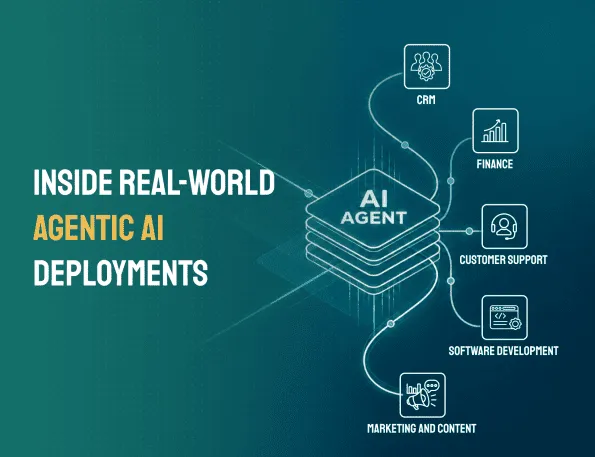
Customer Operations
Customer-facing operations were among the first places businesses experimented with AI, and agentic systems are taking this considerably further than the scripted chatbots that came before.
An agentic customer support deployment does not just identify which category a query falls into. It retrieves the customer’s account history, checks order status across fulfilment systems, identifies whether an exception to policy is warranted based on customer value or previous interactions, drafts a resolution, and in many cases completes the action such as issuing a refund, updating an order, escalating with context already compiled, without a human touching the ticket.
The difference in throughput and consistency is substantial. More importantly, the agent handles the routine volume so that human agents focus on the cases that genuinely require judgment, empathy, or relationship management.
Sales and Revenue Operations
Sales teams lose significant time to work that is not actually selling: updating CRM records, researching prospects, assembling outreach sequences, coordinating follow-ups. Agentic systems are being used to automate this coordination layer.
A sales agent might monitor inbound signals such as a pricing page visit, a webinar registration, or a trial activation, then trigger an enrichment process, assess fit against ideal customer criteria, draft a personalised outreach message for a representative to review, and schedule a follow-up reminder based on response patterns. The representative sells. The agent handles the machinery around the sale.
In more mature deployments, agents are also being used to surface deal risks, flagging stalled opportunities, identifying when a champion contact has gone quiet, or alerting a manager when a high-value renewal is approaching without a recorded touchpoint.
Finance and Procurement
Finance functions are operationally complex and highly process-driven, which makes them well suited to agentic automation. Invoice processing is an example that many organisations are already addressing: an agent ingests an invoice, extracts the relevant fields, matches it against a purchase order, checks for discrepancies, routes exceptions for human review, and updates the accounts payable system when everything reconciles. A process that might involve four or five people in sequence can be completed with one.
Beyond accounts payable, agentic systems are being used in expense management, supplier onboarding, compliance checks, and financial close processes: anywhere the workflow involves moving structured data through defined decision points.
Software Development and Engineering
Development teams are among the earliest and most intensive users of agentic AI, partly because engineers are comfortable working alongside automated tools and partly because tasks such as writing code, running tests, interpreting logs, and fixing bugs are well defined enough for agents to handle with reasonable reliability.
Agentic systems in engineering contexts can take a ticket, write an implementation, run the test suite, interpret failures, make corrections, and open a pull request, all without a developer manually driving each step. Code review agents can assess a diff against a codebase’s conventions and surface issues before a human reviewer sees the PR.
This is not about replacing engineers. It is about removing the volume of low-complexity, time-consuming work that currently sits between a developer and the problems that actually need their attention.
Marketing and Content Operations
Marketing teams managing large content programmes or multi-channel campaigns are deploying agents to handle coordination tasks that currently require constant human oversight: monitoring campaign performance, adjusting spend allocation based on conversion signals, generating content variations for A/B testing, managing social scheduling, and compiling performance reports with commentary.
An agent operating across these tasks does not replace marketing strategy or creative judgment. It removes the operational burden that currently absorbs significant time and often delays the execution of decisions that have already been made.
The Architecture Behind Agentic Systems
Understanding what agentic AI actually looks like technically helps organisations assess readiness and set realistic expectations.
Most production agentic systems combine several components working in coordination. At the centre is a planning layer, typically a large language model, that interprets the goal, reasons about the steps required, and decides which tools to use at each stage. Around this core are the tools themselves: functions or APIs that allow the agent to take actions in the world. There is usually a memory mechanism that retains context across steps, and a monitoring layer that tracks execution, catches failures, and in some deployments surfaces agent decisions for human review before they are acted upon.
The human-in-the-loop question is important. Not every agentic deployment should operate with full autonomy. Many organisations deploy agents in a supervised mode, where the agent completes research, drafts actions, and presents a recommendation for a human to approve, particularly at high-stakes decision points. As confidence in the system builds and the agent’s behaviour is validated, autonomy is extended. This is the more reliable path to production-ready deployment than attempting full autonomy from the outset.
What Needs to Be in Place Before You Deploy
Agentic AI amplifies what already exists in a business. If the underlying data, processes, and integrations are clean, an agent can move through them efficiently. If they are fragmented or unreliable, the agent will encounter friction at every step, and the results will reflect that.
Data quality and access
Agents make decisions based on what they can read. If CRM records are incomplete, product catalogues are inconsistently formatted, or customer data sits in disconnected systems, an agent operating across those systems will struggle. Data readiness is usually the first thing to assess.
Clear process definition
Agentic systems work best when the workflow they are automating is well understood. This does not mean every edge case needs to be defined in advance, but the primary flow and the decision criteria at key steps need to be explicit. If the process is currently ad hoc or relies heavily on tacit knowledge, the agent design phase needs to start with process clarification.
Integration points
Agents need to connect to the systems where work actually happens. This usually means API access to a CRM, ticketing system, ERP, communication platform, or data warehouse. The integration landscape, including what exists, what is accessible, and what data it exposes, is fundamental to scoping an agentic deployment.
Governance and oversight
An agent taking actions across business systems needs guardrails. Decisions about what an agent is permitted to do autonomously versus what requires human approval need to be made deliberately and reviewed as the system matures. This is as much an organisational question as a technical one.
Evaluation criteria
How will you know if the agent is performing well? Defining success metrics such as accuracy, resolution rate, time saved, error rate, escalation frequency, before deployment is essential for measuring real value and identifying where the system needs refinement.
Common Patterns that Undermine Agentic Deployments
Organisations that have attempted agentic deployments and found them disappointing typically ran into one of a small number of recurring patterns.
The most common is deploying an agent on a process that is not yet well defined enough to automate. If the humans currently doing the work rely heavily on judgment, context, and relationship knowledge, an agent will not replicate that. The right response is to start with a more structured sub-process and build from there.
The second is underestimating the integration work. The AI component of an agentic deployment is often straightforward compared to the effort of connecting it to the systems it needs to operate in. Legacy systems without APIs, data siloes, and inconsistent data models are real engineering challenges that need proper resourcing.
The third is deploying with insufficient monitoring in the early stages. An agent that is making decisions and taking actions needs to be observed closely in the beginning. Not because it will necessarily behave badly, but because the edge cases it encounters in real operation are different from the ones anticipated during design, and the early period is when the system should be refined.
Starting Points that Work
For organisations at the beginning of their agentic AI journey, a few starting points consistently produce results without overextending the organisation:
A focused proof of concept targeting a single, well-scoped workflow. Customer support ticket triage, invoice processing, or sales activity logging are all good candidates because the inputs are structured, the process is defined, and the outcomes are measurable.
A clear human-in-the-loop design from the outset, with explicit decision points where agent actions are reviewed before execution. This builds trust in the system, provides training data for improvement, and allows the scope of autonomy to expand incrementally.
An honest assessment of data and integration readiness before the AI design work begins. The time spent here is not wasted, it is what determines whether deployment will be smooth or difficult.
Building Agentic AI that Holds Up in Production
The difference between a compelling agentic AI demonstration and a system that delivers sustained business value is engineering rigour, data quality, and operational alignment. Agents that work in production are not just AI models, they are systems that combine planning, tool use, memory, and judgment within an operational context that has been carefully designed.
Our agentic AI work starts from business requirements, not technology. We identify the workflows where autonomous operation would create measurable value, assess what is in place and what needs to be built, and design agent systems that are production-ready, with appropriate governance, monitoring, and integration across the platforms a business already relies on.
If you are exploring where agentic AI fits into your operations, speak with our team about what a structured AI adoption approach looks like in practice.
Related reading: The AI Advantage Playbook | How AI and MVP are Reshaping the Product Thinking | Agentic AI Services | AI ML Services
