


Go to Section
Share on


A successful proof of concept is one of the most encouraging moments in an AI programme. The model works. The demo impresses the room. Stakeholders are excited. The question of whether the idea is technically feasible has been answered.
Then the difficult part begins.
Moving an AI proof of concept into production is where most AI projects either mature into something genuinely useful or quietly stall. The gap between a PoC that works in a controlled environment and a system that delivers consistent value in a live business context is wider than it appears, and it is not primarily a technical gap. It involves data infrastructure, integration, governance, organisational change, and a clear-eyed reassessment of what success actually looks like at scale.
For teams that have validated an AI concept and are now navigating that transition, the focus is on why PoCs fail to reach production, what a reliable path forward looks like, and the decisions that tend to determine whether production deployment retains the value the PoC demonstrated.
Why So Many PoCs Stall Before Production
The statistics around AI project failure are frequently cited for a reason — they reflect a real and recurring pattern. Organisations invest in AI exploration, produce results they find promising, and then find that production deployment takes far longer, costs far more, or delivers far less than the PoC suggested.
Understanding why this happens is the starting point for avoiding it.
The PoC used Data that Does Not Reflect Production Reality
This is the most common root cause. During a proof of concept, teams often use clean, curated, or sample datasets. The model performs well on those inputs. In production, data is noisier, more inconsistent, arrives from multiple systems in different formats, and contains gaps that a carefully prepared PoC dataset never exposed. When the model encounters this messiness, accuracy drops and confidence in the system erodes.
The PoC was Scoped for Demonstration, Not Deployment
A PoC answers the question: can this work? It is not designed to answer the question: can this operate reliably in our environment, at volume, under real conditions, integrated with our existing systems? Those are different questions, and the engineering required to answer them is substantially greater. Teams that treat the PoC codebase as a foundation for production often find they are rebuilding a large proportion of it.
There is No Clear Owner of the Transition
A PoC is typically run by a small, focused team with a defined objective and a clear endpoint. Production deployment is less bounded. It requires coordination between data engineering, software development, operations, IT, compliance, and the business function being served. Without a clear owner and a structured handoff, the project drifts after the PoC completes.
The Business Value was Not Defined Precisely Enough
During a PoC, success is often framed in technical terms: the model achieves a certain accuracy, the latency is acceptable, the output looks right. These are necessary conditions, but they are not sufficient to demonstrate business value. If the PoC did not establish what a production system would need to do to measurably improve a business outcome, and how that would be measured, the production deployment has no clear definition of done.
Stakeholder Enthusiasm was Not Translated into Commitment
The excitement generated by a PoC is real but perishable. Without a structured path forward that converts enthusiasm into resourcing, prioritisation, and accountability, the window closes. Competing priorities emerge, the team that ran the PoC moves on, and the project enters a state of indefinite review.
The PoC-to-Production Gap: What Actually Changes
It helps to be explicit about what changes between a PoC and a production system, because underestimating this is the primary reason teams find the transition harder than expected.
Scale and Volume
A PoC might process hundreds of records. Production might require handling thousands of transactions per hour, with consistent latency and zero tolerance for downtime. Infrastructure that worked at PoC scale may not hold at production scale, and designing for scale requires decisions that were deferred during the PoC.
Data Pipeline Robustness
In a PoC, data is often loaded manually, cleaned by hand, or drawn from a snapshot. In production, data must arrive continuously from live systems, be validated automatically, handle schema changes, and feed into the model without human intervention at each step. Building this pipeline is often the most time-consuming part of the production transition.
Integration with Existing Systems
A PoC typically operates in isolation. Production deployment means the AI system needs to talk to CRMs, ERPs, ticketing systems, databases, APIs, and potentially legacy infrastructure. Each integration point has its own requirements, constraints, and failure modes.
Monitoring and Observability
A PoC is watched carefully by the team that built it. In production, the system runs continuously and must be monitored automatically. This means logging predictions, detecting drift in model behaviour, alerting when performance degrades, and maintaining audit trails — none of which are required during a PoC.
Security and Compliance
Processing data in a PoC environment and processing live customer or operational data in production are governed by different requirements. Data privacy, access control, audit logging, and compliance with relevant regulations all need to be addressed before go-live.
Operational Support
After launch, someone needs to own the system. Retraining schedules, performance reviews, escalation paths for edge cases, and processes for handling failures all need to be defined. A production AI system is a live operational asset, not a completed project.
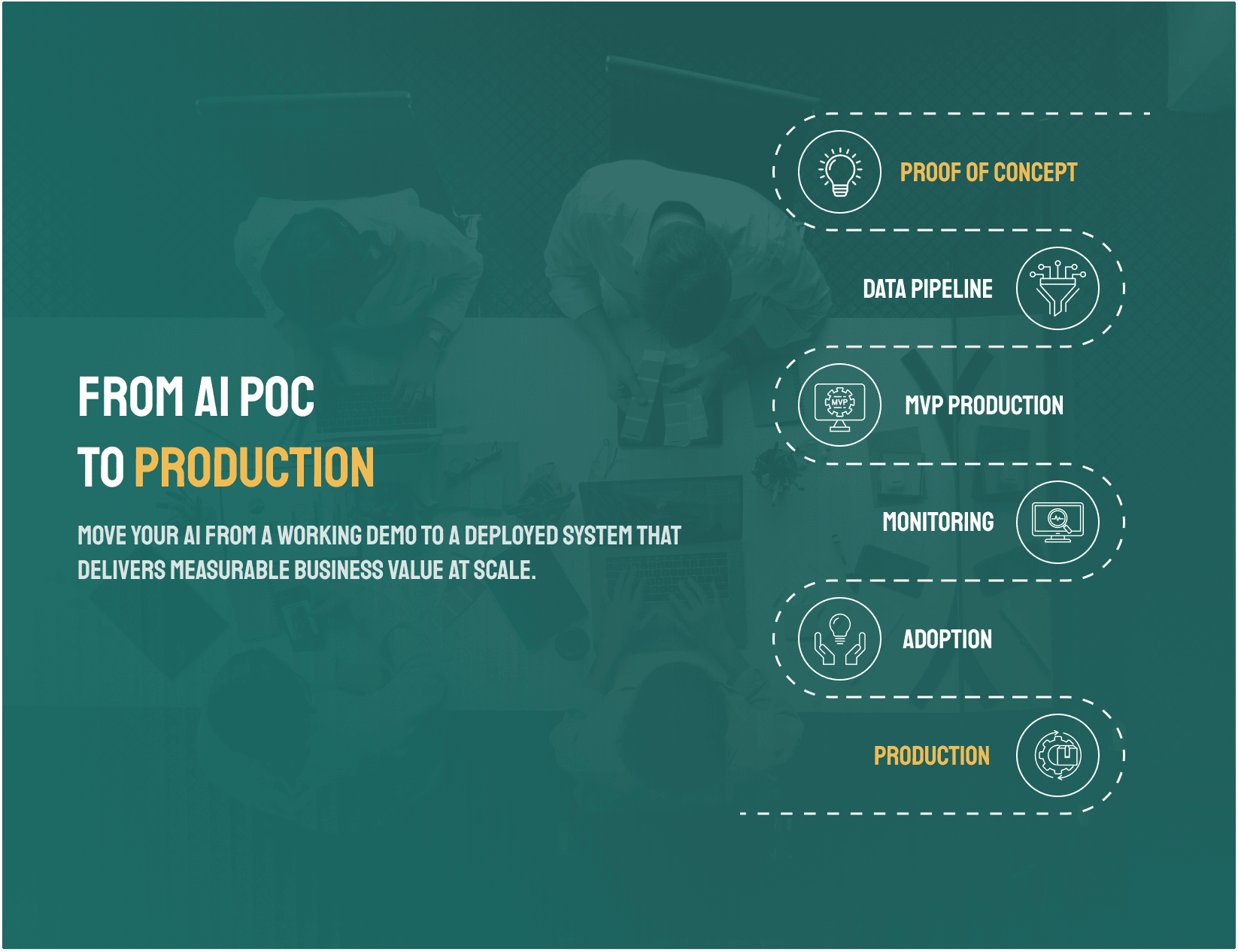
A Structured Path from PoC to Production
The organisations that navigate this transition successfully tend to follow a consistent pattern. It is not about moving faster, it is about moving with the right sequencing and the right rigour at each stage.
- Conduct an Honest Post-PoC Assessment
Before any production planning begins, the PoC should be assessed against production requirements, not just technical performance. This means asking:- What data was used, and how different is it from production data?
- Where were the model’s failure modes, and how will those be handled in a live environment?
- What integrations are required that were not part of the PoC?
- What would a production-grade version of this system actually need to do?
- What is the measurable business outcome that deployment is expected to deliver, and how will it be tracked?
This assessment is not a formality. It frequently surfaces assumptions that were acceptable for the PoC but need to be resolved before production work begins. Discovering them here is far less costly than discovering them mid-deployment.
- Define Production Success in Business Terms
A production AI system needs a clear definition of value that goes beyond model metrics. This means specifying the business outcome it is expected to improve, the baseline it is being measured against, and the timeframe for evaluation.If the AI is being deployed to improve customer query resolution, what does improvement mean — resolution rate, handling time, escalation rate, customer satisfaction score? What is the current baseline? What is the target, and over what period?These definitions need to be agreed before deployment begins, not after. They create accountability, focus the engineering effort on what matters, and provide the evidence needed to justify further investment.
- Treat Data Infrastructure as the Critical Path
In almost every PoC-to-production transition, data infrastructure is where the work accumulates and where timelines slip. This is the place to invest early and thoroughly.This means auditing data sources for completeness and consistency, designing pipelines that can handle the volume and variability of production data, building validation checks that catch data quality issues before they reach the model, and establishing processes for handling missing or anomalous data without manual intervention.The model trained during the PoC may need to be retrained on cleaner or more representative production data once the pipeline is in place. This is normal and should be planned for.
- Build the MVP With Production Architecture in Mind
The MVP, the first deployable version of the system should be built to production standards, not PoC standards. This means using the infrastructure, security controls, and integration patterns that will support the system long term, even if the feature scope is deliberately narrow at launch.A narrow MVP built on production architecture is a far stronger foundation than a feature-complete system built on PoC scaffolding. The former can be extended incrementally. The latter typically needs to be rebuilt when scale or operational requirements exceed what the original structure can support. This is the principle of starting small and scaling intentionally, scoping the initial deployment to the highest-value, most tractable use case, validating it thoroughly, and expanding from a stable base. - Design the Human-in-the-Loop Layer Deliberately
For most production AI deployments, the question is not whether to involve humans in the process but where and how. This decision has significant implications for both the system design and the organisational processes around it.Some decisions should be made by the AI autonomously such as routine classifications, low-stakes actions where volume is high and the cost of error is low. Others should be reviewed by a human before execution including higher-stakes actions, edge cases, situations where context beyond the model’s training might matter. And some should always involve human judgment, with the AI providing input rather than making the call.Defining these tiers before deployment is important because they affect the system architecture, the operational processes, and the risk profile of the deployment. They also tend to evolve over time as confidence in the system builds, which means the design should accommodate changes to these boundaries without requiring a rebuild.
- Establish Monitoring Before Launch, Not After
A production AI system that is not monitored is not a production system; it is a risk. Model performance degrades over time as the data distribution in production shifts away from the data the model was trained on. This is called model drift, and it is not a rare edge case. It is an expected feature of deploying models into dynamic environments.Monitoring means tracking the distributions of inputs and outputs over time, alerting when they deviate materially from the patterns seen during development, and having a process for retraining or recalibrating the model when drift is detected.Beyond performance monitoring, production systems need operational monitoring: latency, error rates, integration failures, data pipeline health. These should be in place before go-live so that when issues arise, and they will, the team has the visibility to respond quickly.
- Plan the Organisational Adoption
Technology deployment and organisational adoption are not the same thing. A production AI system that teams do not trust, do not understand, or have not been prepared to work alongside will not deliver its intended value regardless of how well it performs technically.This means investing in change management, explaining to the teams who will work with the system what it does, what it does not do, how decisions will flow differently, and what the escalation path is when the system produces something unexpected. It means involving the operational teams who will use the system early enough in the process to shape how it works, not just training them to use something that was designed without their input.Adoption is not an afterthought. It is part of what determines whether the production deployment generates the value the PoC promised.
The Signals that a PoC is Ready to Progress
Not every PoC should proceed to production, and not every one that should is ready to do so immediately. The signals that a PoC is genuinely ready to progress include:
The core model performance is validated on data that is representative of production conditions, not just the curated PoC dataset. The business outcome the system is intended to improve is clearly defined, with a measurable baseline and agreed evaluation criteria. The integration requirements are understood and technically feasible within the existing infrastructure. There is an identified owner for the production system, with resourcing allocated for development, deployment, and ongoing operation. The data pipeline can be built to support production volume and variability without manual intervention.
If any of these conditions are not met, the right response is not to delay indefinitely but to address the gap specifically — with a clear scope, timeline, and owner — before production planning begins.
From Validation to Value
The PoC is the beginning of an AI initiative, not the end of it. The value is not in the demonstration, it is in the operational system that runs reliably, improves over time, and delivers measurable outcomes for the business.
Getting from one to the other requires treating the transition as a structured programme of work in its own right: with its own assessment, its own architecture decisions, its own data engineering, and its own adoption planning. Organisations that do this well find that their AI investments compound over time, each successful deployment builds the foundations and the organisational confidence for the next one.
Our PoC and MVP development work is designed with production in mind from the outset. We validate concepts quickly, build on production-grade architecture, and support the full transition from a working prototype to a deployed system that delivers sustained business value.
If you have an AI concept you are ready to explore or a PoC you are trying to move forward, speak with our team about what the right next step looks like.
Related reading: PoC & MVP Development Services | Agentic AI in Practice | How AI and MVP are Reshaping the Product Thinking | The AI Advantage Playbook