


Go to Section
Share on


Imagine two people standing in the same room, looking at the same data.
The first says: here is what happened last quarter, here is where revenue came from, here is where we lost customers. They hand you a dashboard. It is accurate, well-organised, and useful. You now know where you have been.
The second says: based on these patterns, here is what is likely to happen next quarter, here is which customers are about to leave, and here is where demand is expected to spike. They hand you a forecast. It has uncertainty built in. But it changes what you do today.
Neither person is wrong. They are answering different questions. And the question your business most needs answered right now is the one that should determine which capability you invest in, not the one that sounds more impressive in a board presentation.
Business Intelligence (BI) and Predictive Analytics are frequently treated as interchangeable, or as a hierarchy where one is simply a more advanced version of the other. Neither framing is accurate. They are complementary disciplines that serve distinct decision-making needs, built on different technologies, requiring different data maturity, and delivering different kinds of value. Choosing between them or sequencing them is a strategic decision, not a technical one.
Making that decision clearly starts with understanding how BI and predictive analytics differ, where each one creates value, and what your business is ready to support.
The Clearest Way to Separate Them
Every analytical tool, regardless of how it is marketed, answers one of four questions about data:
What happened?
Descriptive analytics. Sales were down 12% in March. Churn increased in the 25-34 age cohort. These are statements of fact about the past.
Why did it happen?
Diagnostic analytics. March revenue dropped because a key promotional campaign underperformed in two regions, coinciding with a competitor price cut. This adds context and causality to the facts.
What will happen?
Predictive analytics. Based on current trends and historical patterns, Q3 revenue is projected to be £2.4M, with 18% probability of falling below £2M. This is forward-looking inference from data.
What should we do?
Prescriptive analytics. To reduce the probability of missing Q3 targets, the highest-ROI action is reallocating budget from the underperforming southern region to the northern one. This moves from insight to recommended action.
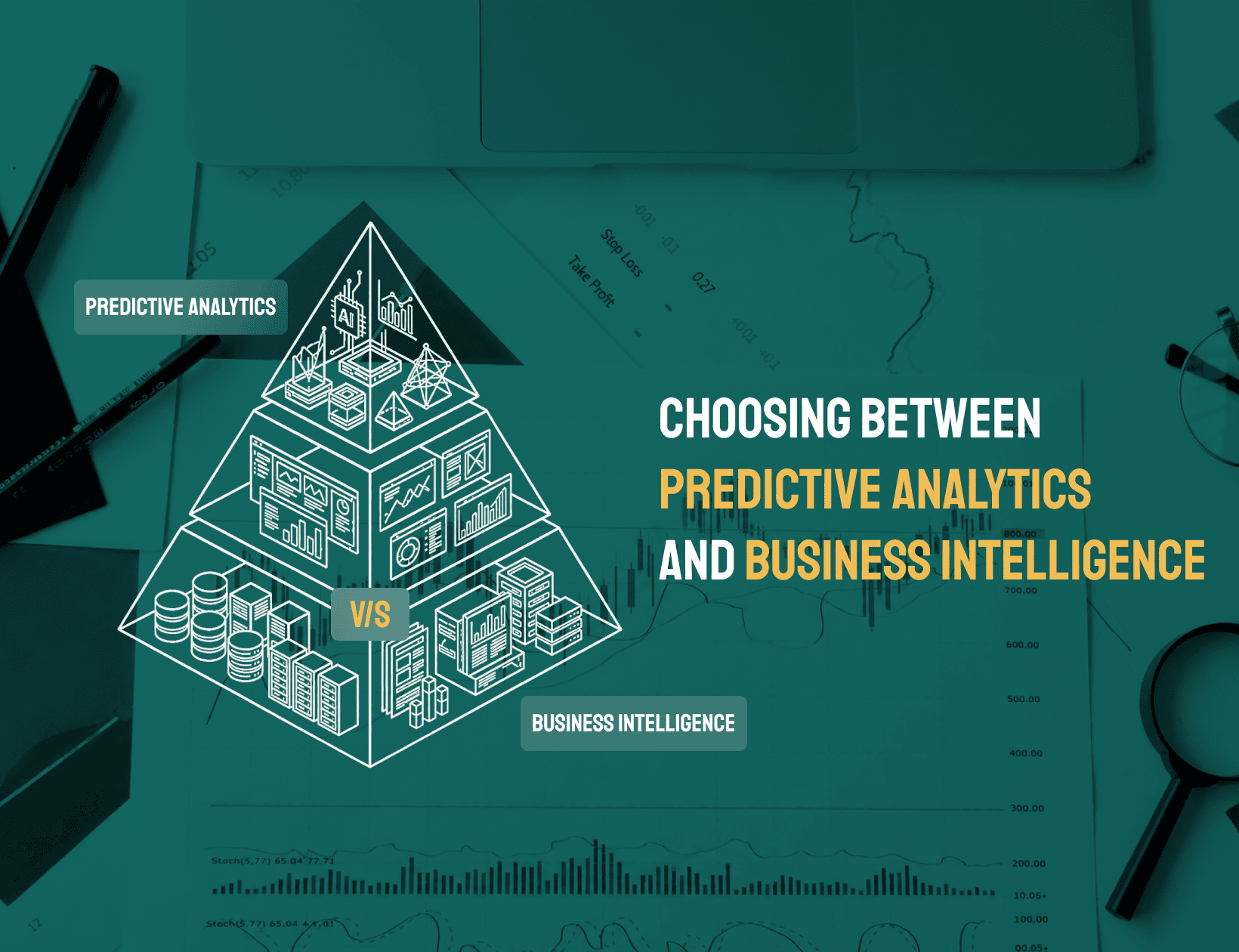
Business Intelligence primarily lives in the first two categories. It is the discipline of understanding what your business has done, with tools, dashboards, reports, data warehouses, visualisations, designed to surface that understanding clearly and consistently to the people who need it.
Predictive Analytics lives in the third category, and increasingly in the fourth. It uses statistical modelling and machine learning to infer what is likely to happen, and in more advanced applications, to recommend what to do about it.
The distinction matters because the two capabilities have fundamentally different requirements. BI needs clean, well-structured historical data and tools that make it accessible. Predictive analytics needs all of that plus models, feature engineering, validation, monitoring, and ongoing maintenance. You cannot build predictive capability on a fragile data foundation. The sequencing is not optional.
What Business Intelligence Actually Gives You
BI is often underestimated precisely because it sounds less exciting than AI-powered prediction. But a well-implemented BI capability is genuinely transformative for organisations that do not yet have one, and genuinely undervalued by organisations that have had it for so long they have stopped noticing what it enables.
What BI provides, concretely:
A shared version of truth
Before BI is in place, different teams frequently operate from different numbers. Sales sees one revenue figure, finance sees another, operations has a third. BI establishes a single, authoritative source that everyone can refer to, which eliminates a category of friction that consumes significant management time in most organisations.
Operational visibility
BI surfaces what is happening across the business in near real-time: which products are moving, which campaigns are converting, which customer segments are growing, which processes are running behind. This visibility is the prerequisite for any intelligent decision-making. You cannot optimise what you cannot see.
Historical pattern recognition
When teams can look back at data consistently, with the same definitions, same time periods, same segmentations, they develop genuine intuition about what drives performance. This institutional knowledge is one of the less-quantified but genuinely important outputs of mature BI.
Accountability infrastructure
Targets become meaningful when they are tracked against reliable data. BI creates the infrastructure that makes performance management real rather than anecdotal.
The honest limitation of BI is that it tells you where you have been, not where you are going. A dashboard showing last month’s churn rate does not tell you which customers are about to leave. A report on last quarter’s demand does not tell you how to staff your warehouse next month. For those questions, a different capability is needed.
What Predictive Analytics Actually Gives You
Where BI says here is what happened, predictive analytics says here is what is likely to happen next, and with what confidence.
The shift sounds simple. The implications are significant.
When a retailer can predict which products will experience a demand spike before it happens, they can adjust purchasing before stock runs short rather than after. When a subscription business can identify which customers show early signals of churn, they can intervene before cancellation rather than offering a win-back discount after. When a logistics operation can forecast maintenance failure probabilities, they can schedule servicing proactively rather than responding to breakdowns.
In each case, the value is in the changed timing of action from reactive to proactive. That shift is the core commercial case for predictive analytics.
What predictive analytics provides, concretely:
Demand and sales forecasting
Statistical models trained on historical sales data, seasonality patterns, pricing signals, and external variables can produce forecasts that are significantly more accurate than manual extrapolation. These forecasts feed planning decisions across purchasing, production, staffing, and marketing.
Customer behaviour prediction
Churn propensity models, lifetime value predictions, next-best-action recommendations, and purchase probability scores are all applications of predictive analytics to customer data. They allow businesses to act on customers individually and at scale, rather than treating them as homogeneous segments.
Risk identification
Credit risk, fraud detection, supply chain disruption probability, and operational failure prediction are all predictive problems. Organisations with mature predictive capability identify risks before they materialise, which is structurally different from managing risks after they appear.
Operational optimisation
Predictive maintenance, dynamic pricing, inventory optimisation, and workforce scheduling all become more effective when they are driven by forecasts rather than historical averages. The system adapts to what is coming, not what has passed.
The honest limitation of predictive analytics is that it requires investment to work well. Models need quality data, careful development, validation, and ongoing monitoring. A predictive system built on poor data will produce confident-sounding forecasts that are quietly unreliable. The infrastructure must come before the insight.
The Decision Framework: Six Questions Worth Asking Honestly
Rather than a simple checklist, think of this as a diagnostic, a set of questions that surface where your organisation actually is, and what it actually needs.
Question 1: Can your teams currently answer “what happened and why” consistently across the business?
If different functions are working from different reports, metrics are defined inconsistently, or building a single view of performance requires manual aggregation in spreadsheets, the foundation for predictive work is not in place. The investment needed is in BI infrastructure: data warehousing, a consistent semantic layer, and reporting that becomes the single source of truth.
Question 2: Is the business already making decisions that would change if you had reliable forward-looking insight?
This is the commercial test for predictive analytics. If the answer is yes, pricing decisions, inventory decisions, marketing spend decisions, retention interventions, then there is a concrete case for the investment. If the answer is unclear, the business may not yet be operating in a way that will extract value from prediction even if it were available.
Question 3: Do you have enough historical data, at sufficient quality, to train reliable models?
Predictive models learn from historical patterns. If your data is sparse, recent, inconsistently recorded, or siloed across systems that have never been integrated, model accuracy will be limited regardless of the sophistication of the algorithms applied. The data question precedes the model question.
Question 4: Is there a specific operational decision you would make differently, and regularly, if you had better prediction?
The most successful predictive deployments are anchored to a specific use case with a defined decision at the end of it. Not “we want to be more data-driven”, but “we want to predict which customers will churn in the next 60 days so that our retention team can prioritise outreach.” That specificity is what allows the system to be designed, evaluated, and improved.
Question 5: Do you have the operational processes to act on predictions?
A model that predicts churn is only valuable if there is a retention process that can act on the prediction. A demand forecast only improves outcomes if procurement and logistics can incorporate it into their planning cycle. Prediction creates value at the point where it changes an action, and that requires the operational process to be ready.
Question 6: Can you maintain a predictive system over time?
Predictive models degrade as the world changes. The patterns a model learned from data two years ago may not hold today. Production deployment requires monitoring, retraining, and ongoing evaluation, which requires either internal capability or a partner who can provide it. A predictive system that is deployed and abandoned will produce increasingly unreliable output over time.
Where Most Businesses Actually Are
Based on these questions, most organisations fall into one of three positions, not as a judgment, but as an honest description of where investment is most likely to create value.
BI investment would create more immediate value when reporting is inconsistent across teams, data is fragmented across systems, or leaders are making decisions based on intuition because reliable data is not available. In this position, predictive analytics built on the existing foundation would produce unreliable results. The foundation comes first.
Predictive analytics can create near-term value when BI is already mature, data is well-structured and accessible, and there are specific high-value decisions that would change with better forward-looking insight. In this position, a focused predictive deployment starting with one use case, built on the existing data infrastructure is a sound investment.
Both are needed in parallel for larger organisations with mature data practices in some areas and gaps in others. A shared services function might have strong BI but no predictive capability, while a customer team might have both, and a new business unit might have neither. Sequencing investment by function and use case, rather than applying a single organisation-wide answer, is usually the practical approach.
The Connection to AI Strategy
It is worth being direct about where predictive analytics sits in the broader AI landscape, because the terminology is sometimes used loosely in ways that obscure the relationship.
Predictive analytics is applied machine learning. The models that forecast demand, score churn risk, or predict maintenance failure are machine learning models trained on historical data to infer patterns that extend to future observations. They are AI in the practical, production sense of the word, not in the conversational AI or generative AI sense that dominates current discussion, but in the sense of software that learns from data to improve decision-making.
This matters because the infrastructure that supports predictive analytics, clean data, robust pipelines, model monitoring, integration with operational systems is also the infrastructure that supports more advanced AI capabilities. Organisations that invest in predictive analytics as a first serious AI use case typically find that they have built the data and engineering foundations that make subsequent AI investments faster and lower-risk.
BI, predictive analytics, and more advanced AI capabilities are not competing choices. They are successive layers of a coherent data strategy, each one creating the conditions for the next.
The Question to Take Into Your Next Planning Conversation
If there is one question that cuts through the noise, it is this: what decision do we make regularly that would be materially better if we could see what is coming?
If you can name that decision specifically, the purchase order, the campaign spend, the staffing level, the customer intervention, and if you have the data that would inform a model capable of predicting the relevant outcome, then predictive analytics has a concrete case. If the answer is vague, or if the data foundation is not yet there, BI investment will create more value sooner.
Our predictive analytics work starts with that question. We help organisations identify where forward-looking insight would change high-value decisions, assess what the data foundation looks like, and build models that are integrated into the operational processes where they create actual impact, not demonstrations that live outside the systems where decisions get made.
If you want to think through where your organisation sits in this picture, talk to our team.
Related reading: Predictive Analytics Services | The AI Advantage Playbook | Agentic AI in Practice | How AI and MVP are Reshaping the Product Thinking | AI ML Services