


Go to Section
Share on

ProductCart reaches its published end of life date on 11 January 2027, when technical support and NetSource managed hosting end. Businesses using other hosting arrangements also need to plan their next steps because the platform depends on services maintained by NetSource.
Choosing a replacement starts with understanding what your business needs. Your store may rely on specialist pricing, configurable products or connections to accounting and inventory systems. These requirements should guide your platform selection.
Planning now gives you time to compare suitable options, prepare your data and test the new store before launch. It also creates an opportunity to improve how customers shop and how your team manages daily operations.
Identify Your Business Requirements
Before comparing platforms, document how your business operates.
Start with your catalogue. Record product types, variants, bundles and configurable items, including any rules that guide customers through their selections. A business selling standard products will have different priorities from one offering items built to order.
Review customer accounts and pricing. Trade buyers may need account approval, agreed prices, quantity discounts or purchasing on credit. These requirements should inform your platform shortlist.
List connections to accounting, inventory, ERP, CRM and fulfilment systems. Establish which system manages each type of information and how updates should move between them.
Include payment methods, delivery calculations, tax settings and checkout requirements. Accessibility, staff permissions and security arrangements should also form part of the assessment.
Speak with the people managing the store. Their experience can help identify opportunities to simplify product updates, order processing and reporting.
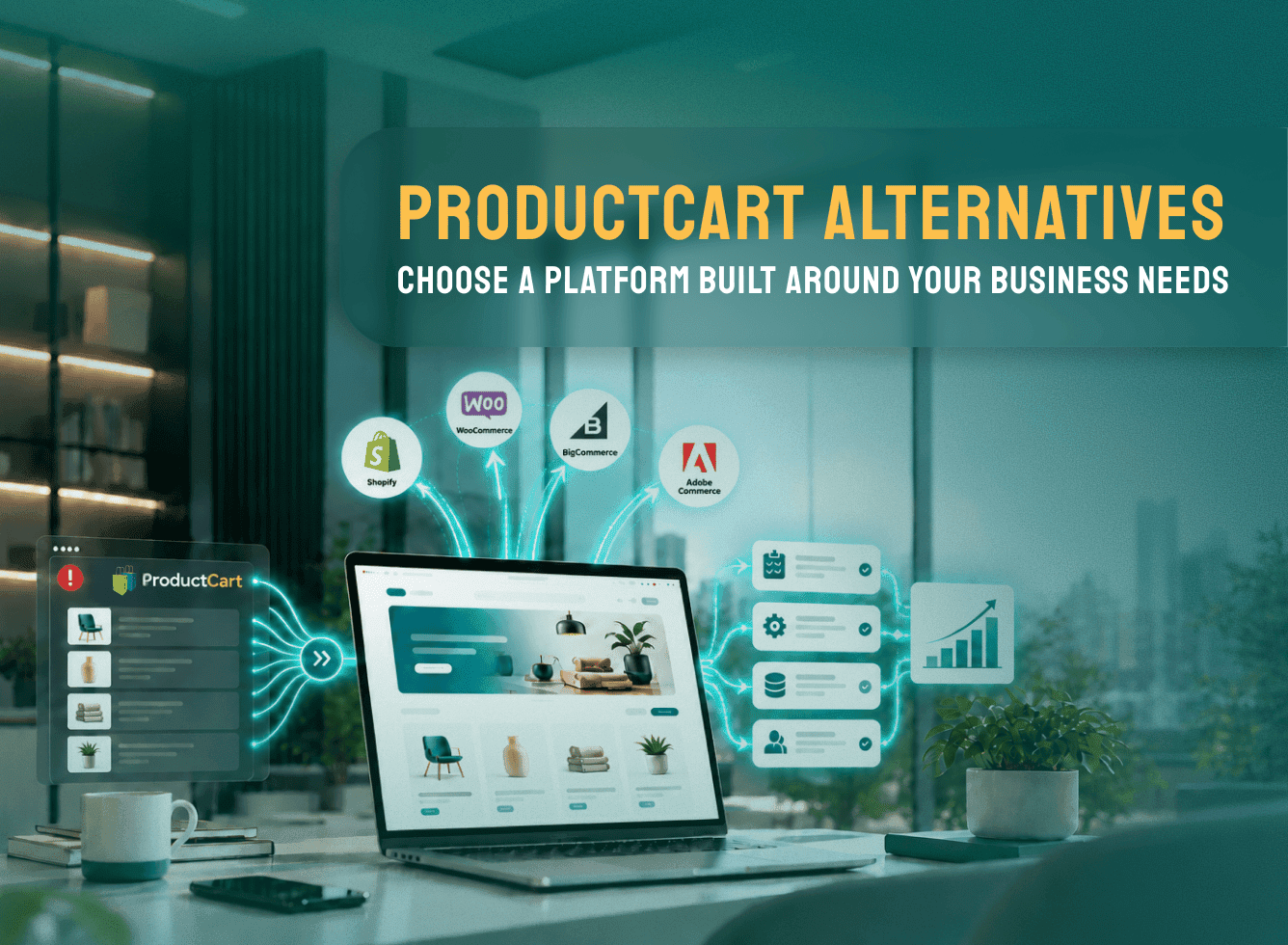
Explore Your ProductCart Replacement Options
Each platform offers a different combination of functionality, flexibility and management tools. Comparing them against your requirements helps you identify the most suitable foundation for your next store.
Shopify and Shopify Plus
Shopify brings products, orders, customer information and storefront management together in a hosted platform. It is worth considering when straightforward administration and managed infrastructure are priorities.
Shopify Plus provides additional capabilities for businesses with more advanced operational requirements, including further checkout customisation and B2B catalogue options. The appropriate plan depends on the functionality your business needs.
Assess how product options, trade pricing and custom ordering processes will work in the new setup. Native functionality, selected apps and development can be combined around your requirements.
Consider how staff will manage promotions, update products and process orders. Demonstrating these activities helps confirm the right configuration and supports training and launch preparation.
The migration can bring your catalogue, customer accounts and connected systems into a setup that supports how your team works, with the plan and functionality selected around your requirements.
WooCommerce
WooCommerce brings ecommerce into WordPress, giving businesses flexibility over website content, design and store functionality. Its open source foundation supports development around specific business requirements.
It is particularly relevant when product sales and editorial content need to work closely together. Product pages, buying guides, service information and other content can be managed within the same WordPress environment.
Established extensions and custom development can support product configuration, pricing and integrations. Your assessment should also consider how staff will publish content, manage orders and maintain product information.
Your new store can combine content and ecommerce management, with hosting, extensions and ongoing support arranged around your business.
BigCommerce
BigCommerce combines a hosted commerce platform with capabilities for consumer and business selling. Its B2B offering includes tools relevant to company purchasing, quotations and customer pricing.
This makes it an option to assess when your business wants managed infrastructure alongside support for established commercial processes.
Migration planning can map ProductCart catalogue structures, customer groups and ordering journeys to the appropriate BigCommerce capabilities. Review the proposed plan and any additional services against your requirements.
Testing a complete purchasing journey helps establish how the store will serve customers and internal teams. This can include checking stock availability, applying customer pricing and passing orders to connected systems.
Planning the move around your existing sales processes helps connect product management, customer pricing and order fulfilment within the new store.
Adobe Commerce
Adobe Commerce supports businesses with detailed catalogue and purchasing requirements. Its B2B functionality includes company accounts, purchasing permissions, customer specific catalogues and negotiated quotations.
These capabilities are relevant to merchants serving business customers with several buyers, approval processes or individual commercial agreements.
Define the intended customer experience alongside administration and integration requirements. For example, a business buyer may need to request a quotation, obtain approval and place an order using agreed payment terms.
Mapping these scenarios helps shape platform configuration, extensions and development. It also provides a basis for agreeing delivery phases and testing.
The implementation can bring complex purchasing requirements into a coordinated solution, with room to develop functionality as your business grows.
Headless Commerce
Headless commerce separates the customer facing storefront from the system handling commerce functions. It gives businesses freedom to develop the shopping experience while using a commerce platform behind it.
This approach can support a distinctive storefront or several digital channels sharing commerce capabilities. It can be considered alongside platforms such as Shopify, BigCommerce and Adobe Commerce.
Start with the customer experience you want to offer and your wider digital plans. Identify where a separately developed storefront would support a specific business objective, such as a tailored buying journey or a connected mobile experience.
A coordinated approach to the storefront, commerce engine and integrations gives your team a clear foundation for managing and developing the experience.
Custom Ecommerce Development
Custom ecommerce development creates a solution around the way your business operates. It is relevant where specialist product configuration, calculation rules or ordering processes are central to the store.
Business requirements can guide the customer interface, administration tools and connections to internal systems. Existing ProductCart workflows provide useful examples for defining the replacement and agreeing how it should behave.
An assessment helps identify functionality to retain, improve or rebuild. Testing can then follow real scenarios used by customers and staff.
The project can be shaped around your immediate priorities, with future development, documentation and support included in the planning.
Understand the Investment and Ongoing Costs
Compare each proposed solution over a consistent period, such as three years.
Include design, development, data migration, platform subscriptions, hosting, extensions and integration services. Account for payment processing and ongoing support using your expected trading volumes.
Ask providers to explain what each proposal includes and how future improvements will be delivered. A clear scope makes it easier to compare options and allocate investment.
Consider staff time as well. Improvements to product updates, order handling and reporting can contribute to the value of the new platform.
Review Data Migration and SEO Requirements
Review how products, customer records, addresses and historical orders will be organised in the destination platform. Confirm which information will be transferred, restructured or retained in an accessible archive.
Plan customer account access and any communication needed to introduce the new experience.
For SEO, review URL structures, redirects, content, metadata and navigation. Map existing pages to suitable destinations and retain useful information that customers find through search.
Include analytics and purchase tracking in the migration scope. Accurate reporting will help your team assess performance and prioritise improvements after launch.
Consider Ongoing Support and Future Development
Agree how the store will be supported once it launches.
Define responsibilities for platform configuration, extensions, integrations and custom functionality. Where relevant, include hosting, software updates, backups and recovery arrangements.
Establish a clear contact for support and a process for coordinating work across connected services. Training and documentation should help your team manage routine activities confidently.
Confirm access to domains, platform accounts, analytics and other business services. Code ownership and data export arrangements should also be documented.
These foundations support continuity and give the business a practical route for future development.
Evaluate Your Shortlist for Daily Operations and Future Growth
Ask providers to demonstrate real purchasing scenarios. A trade customer configuring a product, receiving an agreed price and placing an order provides a useful test of several requirements together.
Invite staff responsible for products, orders and marketing to review the administration tools.
Assess relevant expansion plans, including international sales, additional brands and marketplaces. For AI search and shopping, consider how product information can be maintained and shared with supported channels.
Use these findings to choose a platform that meets current requirements and supports your next stage of growth.
Take the Next Step Towards Your ProductCart Store Replacement
Vsourz helps ProductCart merchants assess their existing stores, compare replacement platforms and plan migration around their business requirements.
Our ProductCart Migration Services cover platform selection, development, data migration, SEO planning and launch support. If you are considering your next platform, contact us to discuss your ProductCart migration. Reviewing your current store provides a practical basis for agreeing the scope, budget and delivery plan.
Related reading
ProductCart Migration Services | Ecommerce Consultancy | Shopify Development | Shopify Plus Development | WooCommerce Development | BigCommerce Development
