


How Enterprises Can Choose Between Custom LLMs and Off the Shelf AI Solutions
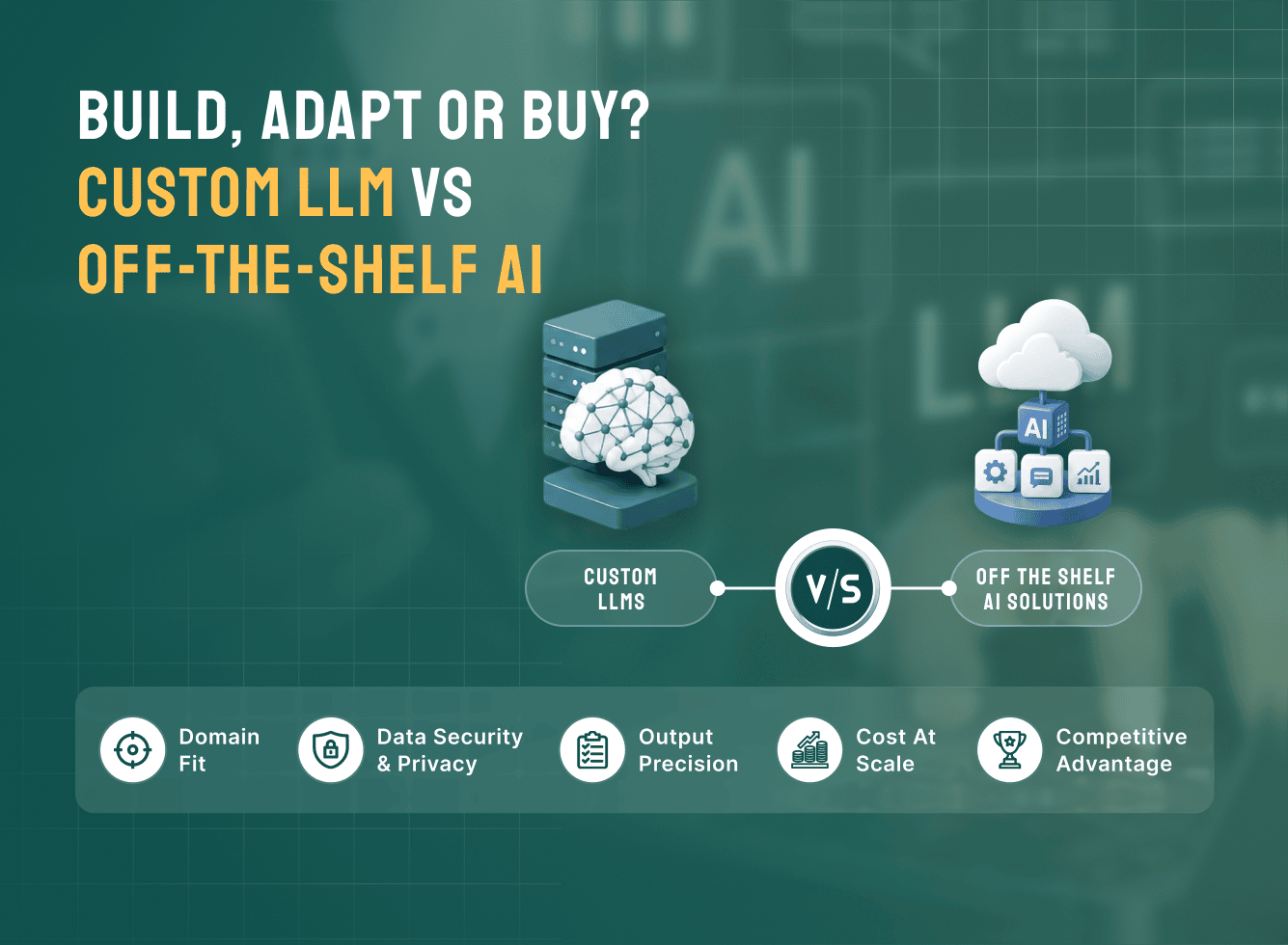
The question arrives in two very different circumstances. In the first, an enterprise has just seen a competitor announce an AI capability that seems to give them an edge. The instinct is to match it quickly, visibly, decisively. The conversation in the boardroom moves fast: we need our own AI. Custom models are discussed. Timelines are set. The strategic intent is real, but the decision is being made before the right questions have been asked.
In the second, a team has spent several months building workflows on top of a general-purpose AI API. It works well enough, but cracks are appearing: the model does not understand their terminology, it produces outputs that need extensive human review, it cannot be trained on proprietary data for compliance reasons, and the cost per query at scale is making the economics uncomfortable. The question arrives from necessity, not ambition.
Both conversations end at the same place, should we build something custom, or is off-the-shelf the right answer? But they are asking it for very different reasons, and they should receive very different answers.
This is a genuine decision with genuine consequences either way. Getting it wrong in the direction of over-building costs millions and delivers years of delay. Getting it wrong in the direction of under-building means deploying something that cannot do what the business actually needs, and eventually rebuilding it anyway, at greater cost, with greater organisational frustration.
The framework that follows is designed to cut through the noise and land on the right answer for each specific situation.
Why the Binary Framing is the First Thing to Abandon
The instinct is to treat this as a binary: build your own LLM, or use someone else’s. In practice, the decision space is a spectrum with five meaningfully distinct positions, each with a different cost profile, capability ceiling, time to value, and ownership requirement.
Position 1 – Off-the-shelf via API, unchanged
You call a foundation model such as GPT-4o, Claude, Gemini, Llama, through an API and send prompts as-is. No customisation beyond prompt design. Fast to start, low cost to experiment, maximum dependency on the provider. Suitable for general tasks where the model’s broad training is a feature, not a gap.
Position 2 – Off-the-shelf with prompt engineering and RAG
You augment a foundation model with retrieval augmented generation, using a vector database that stores your company’s documents, policies, and knowledge. This database provides relevant context to the model at query time. The model itself remains unchanged, but its responses are grounded in your proprietary information. This is one of the most underrated positions on the spectrum, delivering significant contextualisation without the cost or complexity of model training.
Position 3 – Fine-tuned foundation model
You take a pre-trained foundation model and train it further on a curated dataset specific to your domain, your terminology, your tone, or your task type. The base model’s general capability is preserved; the fine-tuning steers it toward your specific needs. The compute cost is a fraction of training from scratch. The resulting model can be deployed via the original provider’s API or self-hosted depending on the model and licence.
Position 4 – Custom-trained domain model
You train a model from scratch or train a significantly modified architecture on a large corpus of domain-specific data. This is appropriate for genuinely specialised domains where general-purpose models have significant capability gaps: clinical medicine, financial regulation, highly technical engineering fields, or languages and dialects underrepresented in foundation model training data.
Position 5 – Fully proprietary foundation model
You build and train a foundation model at scale, billions of parameters, vast compute requirements, dedicated infrastructure. This is what the handful of AI laboratories in the world have done. For the overwhelming majority of enterprises, this is not a live option. It requires investment measured in hundreds of millions, infrastructure measured in thousands of GPUs, and teams measured in hundreds of specialised researchers.
Most enterprise decisions are somewhere between Positions 1 and 4. Position 5 exists primarily to close the conceptual map, not as a realistic path for most organisations.
What Each Position Actually Costs
Cost comparisons between these positions are frequently distorted by vendor enthusiasm in one direction or custom-build enthusiasm in the other. Here is a more grounded view across four dimensions: initial investment, ongoing operational cost, time to first value, and total cost of ownership at scale.
Position 1 (API, unchanged)
Carries near-zero initial cost, the price of a developer’s time to integrate. Ongoing cost is per-token API fees, which are manageable at low volume but grow with scale. Time to first value is days. Total cost of ownership at significant scale can become the dominant concern, particularly for high-volume applications.
Position 2 (API + RAG)
Adds the cost of building and maintaining a retrieval pipeline and vector database, plus the ongoing cost of keeping the knowledge base current. Initial investment is typically weeks of engineering work. The performance-to-cost ratio at this position is unusually favourable, you get substantial domain grounding for relatively modest investment.
Position 3 (fine-tuned model)
Requires a curated training dataset (which is the real work and the real cost), compute time for the fine-tuning run, and evaluation effort to validate the result. Initial investment ranges from weeks to a few months depending on dataset quality and task specificity. The ongoing cost depends on hosting choices, using the provider’s fine-tuned model hosting versus self-hosting infrastructure.
Position 4 (custom domain model)
It is a material investment. Building a quality training corpus for a specialised domain, running training at meaningful scale, evaluating the model, and deploying it requires a dedicated team and significant compute. The organisations that justify this investment typically have a domain where Position 2 and 3 demonstrably fail to meet accuracy or compliance requirements, and where the model will be used at sufficient scale for the economics to work.
The comparison that trips most enterprise teams is measuring Position 4 costs against Position 1 costs and concluding custom is too expensive, without ever properly evaluating Position 2 or 3, which often deliver most of what they need at a fraction of the investment.
The Five Dimensions that Should Drive the Decision
Rather than starting with the budget question, the more reliable path is to first characterise the requirement across five dimensions. Where each dimension lands points clearly toward different positions on the spectrum.
-
Domain Specificity
General-purpose foundation models are trained on broad internet text. They know a great deal about medicine, law, finance, and engineering, but they know it at the level of publicly available generalist content. They understand common terminology in these fields reasonably well.
The question is whether your use case requires something beyond that. If your business works with proprietary contract structures that no public training data resembles, regulatory frameworks specific to a jurisdiction, clinical classifications that differ from published guidelines, or technical specifications that exist only in internal documentation, the general model’s knowledge has a structural gap that prompt engineering alone cannot close.
The further your domain sits from general internet text, the further right on the spectrum the decision should move.
-
Data Sensitivity and Sovereignty
This dimension is frequently underweighted until a compliance team raises it, at which point it becomes the dominant factor.
Sending business data to an external API means that data travels to and is processed by a third-party infrastructure. For many use cases, this is acceptable. For others, certain healthcare data, regulated financial information, government or defence applications, data subject to specific contractual confidentiality obligations, it is not.
The question is not just whether it is technically possible to use an API (it usually is) but whether doing so is compatible with your data governance obligations. If the answer is no, or even “we are not sure,” the decision shifts toward self-hosted models, which begins to point at Position 3 or 4, depending on customisation requirements.
-
Required Output Consistency and Precision
Some applications require outputs that are highly consistent, use specific terminology precisely, follow defined formats reliably, and behave predictably across a wide range of inputs. Think of a legal document generation system, a clinical coding tool, or a financial report generator.
General-purpose models have variability built into them, they are designed to produce plausible, natural text, not to produce exactly the same structured output to exactly the same specification every time. Prompt engineering can constrain this significantly, but there is a ceiling.
Fine-tuning substantially improves output consistency for specific task types. For applications where precision and format are non-negotiable, the case for moving beyond Position 1 or 2 strengthens considerably.
-
Deployment Volume and Unit Economics
At low query volumes, API costs are immaterial. At enterprise scale, millions of queries per month, high context documents, real time processing requirements, the economics change fundamentally.
The crossover point where self-hosting or fine-tuning becomes more cost-effective than API consumption varies by use case, but it tends to arrive sooner than teams expect when they model actual production volumes honestly. If your application is designed to process every customer interaction, every document, every transaction, the unit economics of API dependency should be modelled carefully before commitments are made.
-
Competitive Differentiation
The most strategically interesting dimension, and the one most often handled carelessly in both directions.
On one hand, building a custom model purely for the optics of having one, without a genuine capability gap that public models cannot fill, is expensive theatre. The competitive advantage is not in the model itself; it is in the product, the workflow, the data, and the execution.
On the other hand, if the AI capability is genuinely central to your product’s differentiation, if it is the thing customers are paying for, the thing competitors cannot replicate without access to your proprietary training data, then building and owning it is a strategic investment, not a cost. The model becomes an asset, not a service line.
The honest question is: would our AI capability be meaningfully better if we owned the model, or are we just uncomfortable with dependency?
A Map Through the Decision
Running these five dimensions against the five positions on the spectrum produces a navigable map rather than a rigid rulebook. The patterns that emerge consistently point to the same conclusions.
When to start at Position 1 or 2
This use case is well-served by general knowledge, data sensitivity is manageable under existing API agreements, output consistency can be achieved through prompt design, volume is uncertain or early-stage, and the AI function is a supporting capability rather than the product itself. In this situation, RAG (Position 2) will typically deliver more value than raw API use and should be the default starting point for any enterprise deployment, not the fallback.
When to move to Position 3
There is a measurable quality gap between what the fine-tuned model can do and what the general model produces on your specific task. This is best discovered empirically: run the general model, measure its performance, identify where it fails, and then evaluate whether fine-tuning on a representative dataset closes that gap to an acceptable level. Fine-tuning is often underexplored because teams jump straight to “build custom” without testing whether a more accessible solution exists.
When Position 4 becomes the right answer
The domain is genuinely specialised in a way that creates structural gaps in foundation model capability, data sovereignty requirements make third-party API use incompatible, and the scale of deployment makes the investment economically sound. All three conditions typically need to be present. Any one of them alone is rarely sufficient to justify the investment relative to alternatives.
The Mistake that Costs the Most
In practice, the most expensive error is not choosing the wrong position on the spectrum. It is choosing the right position for the wrong reason, specifically, pursuing custom development because of strategic ambition rather than genuine capability need, and discovering partway through the investment that a fine-tuned model on a third party API would have delivered 90% of the value at 20% of the cost.
The diagnostic test for this is simple and worth running before any custom development commitment is made: take the best-available off-the-shelf model, apply serious prompt engineering and RAG on your data, and measure its performance against your actual success criteria. Do not estimate how it will perform. Measure it. If it meets your criteria, you have avoided a significant misdirected investment. If it falls short in specific, identifiable ways, you now have a precise brief for what custom development needs to solve, and that precision makes the custom work considerably more tractable.
The organisations that navigate this decision well are the ones that treat it as an empirical question rather than an architectural preference.
Where Custom LLM Development Creates Real Value
None of this is an argument against custom LLM development. For the right use cases, it creates durable competitive advantage, delivers capabilities that are genuinely impossible to replicate with general models, and establishes proprietary AI assets that compound in value as the underlying data grows.
The industries where this case is strongest are those with large proprietary text corpora, high requirements for precision and consistency, genuine domain specificity that general models underserve, and deployment scale that makes the economics work. Financial services, healthcare, legal technology, and industrial applications with specialised technical documentation frequently meet multiple of these criteria simultaneously.
Our LLM work spans the full spectrum, from RAG implementations that deliver enterprise-grade performance on existing infrastructure, to fine-tuning engagements that close specific capability gaps, to custom development for clients where the strategic and technical case genuinely supports it. We start every engagement by helping clients understand which position on the spectrum is right for their situation, because the best custom LLM work begins with an honest assessment that it is the right answer, not an assumption that it is.
If you are working through this decision, speak with our team. The right answer is specific to your use case, your data, and your constraints, and it is worth getting right before the investment begins.
Related reading: Large Language Model Development Services | Custom AI App Development | Agentic AI in Practice | AI ML Services | How to Move an AI PoC Into Production Without Losing Business Value